Latina Muslims: The Choices They Make. CATALINA Magazine. Nov-Dec 2002.
By Ramin Ganeshram
http://www.catalinamagazine.com
You can say 27-year-old Zulayka Martinez was a typical Latina. As the child of a strictly religious family, she went to Catholic youth groups and could name all of her saints. She even dreamt of becoming a nun one day. Then, at age 22, while at a Catholic retreat, her life changed forever. She converted to Islam. "I brought a Quran that a Muslim coworker had given me to the retreat." Martinez explains. "I read it during the times of silence and reflection. It spoke to my heart, which made me very confused about my faith in my own religion." The anxious young woman did what good Catholic girls do: she confessed to her priest. He promptly told her, "I've read the Quran. I'm not saying Muslims are bad people, but I'm assuring you that our faith is correct and theirs is not." His response only fed her curiosity. She began to ask Muslim classmates for increasingly more information, while reading any material she could find about the religion. After a few more years of studying, she took the plunge and followed in thefootsteps of thousands of Latinas. She took her Shahada - theMuslim oath of conversion. Martinez's story may sound unusual, but it's not. Groups like Latino American Dawah Organization (LADO), founded in 1997 to aid Islamic conversion in Hispanic communities, and the Islamic Association of North America (ISNA) estimate the number of Latino Muslims in the United States at around 50,000.
With mosques and missionary groups in almost every Central and South American country, there is strong belief among Muslims that the number will rise substantially. According to ISNA spokesperson, Dr. Syeed Sayed, women generally convert to Islam more often than men. The main question to ask then is "Why?" A large proportion of Latina converts are women like Zulayka Martinez, who pinpoint their initial exploration of Islam not to outside influences but to an extreme dissatisfaction with the teachings of the Catholic Church. Scandals and bureaucratic hierarchy are blamed for the Catholic Church's more than 100,000 defections yearly, in just the United States alone. "Even when I was a Catholic, I rarely agreed with the Church," says Marlene Lillo-Smith. "I don't agree with priestly power, or the fact that the Pope is one of the richest men in the world -that is obscene." For this 41-year-old Chilena, who became Muslim two years ago, the lack of intermediaries between God and the Muslim faithful was very attractive in her new religion.
Samantha Sanchez, 25, a LADO cofounder who converted to Islam in 1997, has conducted studies about how Hispanics come to this faith. "Seventy-five percent of Latino Muslims came through personal exploration. These people were going out to explore everything from Buddhism to Wicca and settled upon Islam," saysSanchez.
For 38-year-old Dyeanna Luna, conversion meant the end of her marriage, losing her three daughters and many friends. Her Mexican parents feel she is going to hell and her brotherscall her "the wife of Bin Laden." Still, Luna has persisted -even convincing her employer, Southwest Airlines, to allow her to wear hijab while doing her job as a ticket counter agent. "I will admit that it made a lot of customers a bit nervous, especially after September 11th, but it is important to me to follow my faith,' she says. "The people who really know me know I am a good person and don't make me feel bad about my decision."
Aisha (Becky) Serrano's family didn't take her conversion well either. The 17-year-old senior at American High Schoolin Fremont, Calif. learned about Islam thorough friends. "I come from a traditional Mexican family, and they are very upset that I have accepted Islam," she says. "I have to sneak my Quran into the house and I keep my hijab in the car so I can change before I go to school."
Khadija (Vita) Rivera, who started a group called Piedad in 1988 to ease Latinas' transition to Islam, says the phenomenon of young Latinas who hide their Muslim lives because of fear offamily is common. Rivera says Latina Muslims face a strong belief by family, friends and society that they are being forced and tricked intoparticipating in an oppressive religion. They condemn exposure to Muslims living in America, or convince themselves that the women accepted Islam to please a Muslim boyfriend or husband. "The Spanish public can't fathom that we would convert without marrying a Muslim man, but they should know better than anyone that Latina women are not going to let Themselves be oppressed - we would yell and scream," says the 51-year- old native New Yorker and Muslim convert of 20 years who now lives in Miami.
Many of the Latinas said their families are so against conversion because they fear their girls will give up their Hispanic culture by adopting Muslim names, or wearing Arab or South Asian clothing. Yet, changes in dress, eating habits, and behavior do not mean one's Hispanic heritage is being lost, the new converts say."I really think it is American and Latino society that oppresses women, and Latinas in particular, by pressuring us to be J-Lo and Carmen Miranda wannabes," says LADO's Sanchez. " I think that Islam is the answer, because it takes away stereotypical Latina-ness. You are Latina because you are, not because you dress in a provocative way." "Are we, as a community, really equating being Latina only with eating pork, drinking liquor, and being a coqueta?" she asks. "If so, then we have a pretty sad self image."
Familial and social pressures aren't the only ones some Latina Muslims deal with. They also feel pressures from their new, chosen communities. "A lot of Arab and Indian Muslims don't realize that Islam is not only for them, it's for everyone," says Lucy Chapa, 32. "I feel more comfortable around other LatinoMuslims." Dyeanna Luna has also felt unwanted and is gratefulfor groups like Ramirez' and LADO that help her through the difficult times. "Things definitely have been very hard since I've accepted Islam. I've had problems from all sides: my family, friends,and even `ethnic' Muslims," says Luna. "But, God tells us youmust choose who you love more: God or mankind. And Islam has helped me see that I love God more."
Friday, February 9, 2007


Dr T B Irving-Frontier for Latino Dawah in USA

Dr. Irving was once a fixture at Muslim conventions. I met him and was sincerely moved by his professional presentation at one of our PIEDAD lectures on Mudejar Art in Latino America. He was inspireing when chatting about Andalusia and how my roots were Hispanic even before birth. He pushed me to lecture and socialize among Latinos and other Muslims. He gave me his braveheart to do outreach inspite of what my Id told me. Al hamdulilah he was my teacher and I am forever greatful of the times I met him or read his books. Allah grant him paradise.
This author, professor, and translator of the first American English translationof the Quran who accepted Islam over 50 years ago passed away peacefully on the morning of September 24, 2002 in his Mississippi home. He had been suffering from Alzheimer's disease. Few Muslim publications or media know about his death or published anything about his condition while he was sick. We need to remember our scholars. We need to be there for them with our concern, our Dua's and our good wishes, especially in the last moments of their lives. Warmly , Khadijah Rivera
==============================================
The state of this translator of the Quran can remind us of Yusuf Ali, another Muslim whose translation of the Quran into English is world renown. Yusuf Ali did not need money to take care of himself. But when he passed away on a cold London night about 50 years ago, he was sick and alone. The Muslim community only came to know later about his death.
Some background on Dr. Irving It was Muslim "stubbornness" which eventually led the Canadian Quran translator and writer Thomas Ballantyne (T.B.) Irving to Islam. "I remember especially a missionary returned from India stating how the 'Mohometans' (Muslims) were so obdurate in adhering to their religion; that was my first encounter with Islam, and it aroused an unconscious admiration in me for their steadfastness to their faith and a desire to know more about these 'wicked' people," he recounted in the book "Islam: Our Choice", a collection of interviews with Muslims who have converted to the faith. T.B. Irving later became one of these "obdurate" people, choosing the name Al Hajj Ta'lim Ali Abu Nasr.
Born in Preston, Ontario in 1914, this professor, writer, translator and activist is best known for his translation of the Quran entitled, The Quran: First American Version (1985). The work is an attempt to make the English translation of the Quran more readable to an audience not used to the old style of English common in most translations. Irving was particularly concerned about making the Quran accessibleto Muslim youth in North America."A new generation of English-speaking Muslims has grown up in North America which must use our scripture differently than their fathers would have done. Their thinking roots have become distinct on a new continent without the familiar use of our holy tongue, and a great difference has developed between their customs and their ancestral faith," he wrote in the introduction of his translation, entitled, The Qur'an: The Noble Reading.The cover of the 1993 edition of this translation features a photograph of the dome of the Great Umayyad Masjid of Cordoba, Spain. This provides a hint at another passion of his: Muslim Spain. Irving was considered a leading expert on the Arab-Islamic period in Spanish history, especially with his book 'Falcon of Spain"'. This was astudy of Spain under Muslim rule, with a special emphasis on the Umayyad ruler AbdurRahman I, who Irving considered a "great statesman". Irving's other books in English include: Growing Up In Islam; The Quran: Basic Teachings, which he co-authored with Dr. Khurshid Ahmadand Muhammad Manazir Ahsan; Had You Been Born a Muslim; Religion andSocial Responsibility; Tide of Islam; Islam Resurgent; Islam in its Essence; Polished Jade; Stories of Kalil and Dimna; The Mayas Own Words, as well as various articles on Central American Literature.In Spanish, Irving wrote Cautiverio Babilónico en Andalusía, Nacido como Musulmán, and El Poema de José In addition, he wrote a number of other articles and essays publishedin various journals. Irving learned and taught at a diverse list of universities fromacross the continent, including McGill University in Montreal, Canada, Princeton University in New Jersey, University of San Carlosin Guatemala, University of Minneapolis, and the University ofTennessee, from which he retired as a professor of Spanish and Arabic in 1980. Source Following retirement, he served as the dean of the American Islamic College in Chicago between 1981-1986. It was during his time there that he published his translation of the Quran. His service to Islam as a writer was noticed by the Pakistani government, who rewarded him the Sitara-e-Imtiaz award (Star ofExcellence) for service to Islam in 1983. Dr. Irving's last years Dr. Irving's son, Nicholas, moved from Guatemala to take care of his father. While Dr. Irving did not need monetary or medical help, he would have appreciated hearing from Muslims, especially those who benefited from his work as a writer and scholar. Although he could not talk and could only eat with the help of a feeding machine, he was conscious. I visited him last year, while he was in a nursing home. Standing next to his bed, I felt each time I said Shahadah (the Islamic declaration of faith), he moved as though he was trying to respond to it. May Allah forgive him and grant him Paradise for his contributions to humanity.
Bism Rabbik's footnote:
As a personal friend of Dr. Irving, I feel a great loss and sadness, and will miss him. We have worked together over the years to establish Islam in the Spanish-speaking community. He has written other books not mentioned above, primarily text books, which he has placed in our possession for translation into Spanish. Over time, inshallah, we will translate and publish those books....... Carl Askia El-Amin, Executive Director
Source: Islamic forum at "gawaher"--------------------------------
Un Dios, una gente, y una creencia unica!
In 2001 we submitted this paper as an introduction to ISNA for their convention in Ohio.
PIEDAD
Srs. Aisha, Zeina and Khadijah
(Bismillah ur Rahman ur Rahim) En el Nombre’ de Ala’ el Compasivo el Misericordioso
Al-hamdulilah, it has been part of our illustrious Islamic history to send messengers to different lands to spread the teachings of Al Islam. But for converts to spread the message in their land of choice it’s only the beginning of there Islamic duty!
As Hispanic Americans it is our belief that we should utilize our gift of a second language to teach our brethren right here in the USA our adopted homeland. And with that in mind I come humbly before you to present this paper on how da’wah has developed and it’s future in America.
As Br. Muhammad Abdul Khabeer will testify Islam was brought to the Americas with the New World. On board Christopher Columbus’ ship were the Astrolabe and the Muslim who could work it. For without it, Columbus would have never reached the New World.
Prior to that, the Muslims of Andalucia had enjoyed a rich and glorious history in Muslim Spain for over 700 years. Bringing science and Islam at the forefront of their lives. They breathed Islam in their architecture and rich culture. Their intermarriages and adoption of the “new faith” brought unity rather than segregation for hundreds of years. For the Muslims allowed synagogues and churches to be built and allowed citizens to worship God the Almighty so long as they paid taxes to the Muslims. Our Hispanic roots were merged permanently with the prosperous Islamic culture. I can almost see my Puerto Rican late grandmother turn to me as I said:
Ø “Bendicion abuelita? ” (Blessings Grandma?) and her response was
Ø “Que Dios te bendiga” (May God bless you) where upon I would respond
Ø “Te veo el proximo sabado” (See you next week) and she would say
Ø “Si Dios Quiere” Another words, “Inshallah”.
So we also brought that aspect of our daily lives to the new world as her parents were from Spain. Dr. Thomas Ballentine Irving the leading authority on Muslim Spain once gave me as a gift, pages of Andalucian recipes. It had no pork products, which are so common in Spanish cooking today. Inshallah this books printing is a project that we hope to promote among our jummaat.
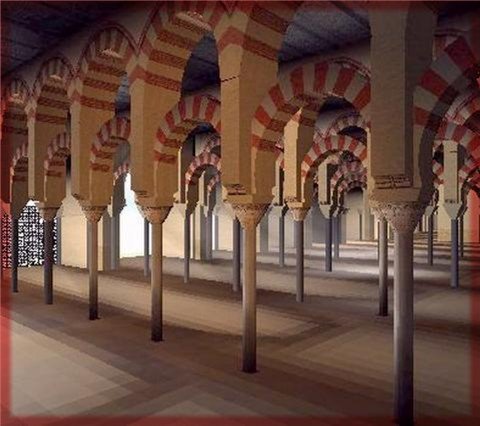
When the Muslims were expelled from Spain many of them left as Mude’jar Artisans. Once they arrived in the New World and Latin America they built churches with Islamic architecture and beautiful lines and fountains. Our lives were so intertwined that we could hardly distinguish one from the other. So that today when da’wah is given to a Christian it is so much easier for them to accept it. I also believe that the mere fact that a Hispanic is giving the da’wah assists greatly for it is more of a natural move and inclination to the faith. I use to wonder why during Malcolm X ‘s period many more Hispanics were not invited to Islam. But now I sigh with a great relief for that.
We are a nation of mostly pious people who took religion seriously throughout history. Whether via Andalucia or the Crusades or the Conquistadors it was always a deep commitment to a higher truth.
In New York City I found a Puerto Rican family who taught their children Islam as babies and now they can be joyful that they have Hafiz and upright Muslims. One of the main reasons we come is for the security it brings our family life and the love it fosters between our children and even our non-Muslim extended family. Br. Mustafa was known for standing across the street from the big churches with a table full of literature and invite congregates to learn about Al –Islam. In Ohio we have Aisha Moreno of Ecuadorian decent who once asked me how could she do da’wah if she was mostly home. And I told her that if she were sincere they would knock at her door. She has since been teaching from her home and has weekly halaqahs in Spanish and English. In Miami we had 5 shahadahs in one weekend! All over the country masses of Hispanics have found inner peace in a faith that is akin to their own culture.
PIEDAD was very active in NYC where we began our work in 1987. Our first seminar was at a club where we brought food and invited our extended non -Muslim family. The founders of PIEDAD were not all-Spanish speaking; in fact we had a Kashmiri sister and a Pakistani who understood the importance of da’wah to Latinos. Although we are known for our numerous seminars with speakers like: Iman Siraj Wahaj, Mohammed Nasim, Dr. Thomas Irving, Dr Omar Kasule and others, truth is it was never as productive as our One on One da’wah. It was this personalization of the deen that assisted us. Here we could speak freely and clearly use the dua’ that releases our tongue so that we may be understood.
I remember the day I met Br Yasin he was 17 years old and he wanted to go to Afghanistan. His family did not allow him and he wanted us to convince them. Well that was his objective but that is not what happened. His elder parents were afraid of his new religion and felt is was pure fanaticism, which could get their son killed. We spent what seemed to be hours trying to explain to this humble couple the virtues of Islam. Whereas they complained about their son and how he took down their portraits from the wall and the infamous Christmas tree in all it’s glory. Oh yes, they believed he was totally crazy. Why he didn’t even eat! We asked him if perhaps he was eating at night and explained what fasting was. “Oh yes” answered his father.” He is like a little mouse and eats when we are in bed.” Al Hamdulilah it was clear to us this brother was in the deen. At this point we stopped and really listened to them. They needed their son home and needed to see the difference between Yasin now and then. We asked them what Yasin was doing before he committed to Islam.
“ Oh the father said ” I was getting him out of jail constantly, h e was stealing hubcaps and getting drunk.”
And now?
“Oh no.”, with realization in his breath, ” not now! ”.
That day Yasin’s father converted to Al Islam during Jumaah. Shortly after his nieces and his mother also converted. That is the miracle of Islam. It is as beautiful as it is wondrous.
Certainly, da’wah to any specific group is enriching but also involves lots of frustration as well as time. PIEDAD began as da’wah directed to the overlooked Hispanic women in NYC. And has continued it’s specialization to that intimate group without keeping others from assistance and participation. Working with women was especially rewarding because we come from the same place. Our first step has always been to form sincere and deep friendships that allow mistakes and are non judgmental. Secondly, to teach only what we are sure is correct and for deeper questions always have a sheikh or imam available for advice. Third, and most important to assure the new Muslimah that Islam is for everyone and that we are not to separate ourselves from any other Muslims as “only Hispanic Muslims”. And last but not least, to seek Islamic knowledge for the rest of their lives and never be satisfied with their comprehension but to have the thirst of learning in their hearts solely for the pleasure of Almighty Allah swt.
After a sister learns to make salat and has an elementary understanding of Islam she is directed to the nearest Islamic center to continue her studies and referred to books that she can study to further her knowledge. If a sister wishes to go further in order to serve Allah swt she may want to join us in da’wah and for that we do Daiyett training. Which are basically a continuation of their studies in Islam and the practice of the deen in the service of Allah swt. As we did in Houston Texas with Br. Hussein Shuote and Sr. Aisha Mohammad of NYC several years ago.
It should noted that our specific outreach must often take on a more nurturing role in da’wah, as in the case of young Yasin and the impact of Islam on his family. Also, where single women come to PIEDAD whether young or old there is an urgency to learn their roles as Muslimahs in a household. The precious upbringing of our next generation as well as the shura needed to maintain a good Islamic marriage is at stake. Often we must seek help from the Islamic community to give a support network for these women. Al hamdulilah PIEDAD has outstanding sheikhs and imam’s assisting us 24/7.
This paper is to be used to understand the need of da’wah to Hispanics due to their history and
For the development of the Hispanic community I have purposely outlined a Wish List of goals we are setting for our enrichment and progress. We hope that you will assist in its general development and generate a discussion so that we may improve in our da’wah direction.
======================================
Our wish list for Da’wah in the USA
Ø Funding for Da’wah groups to assist them in their challenging work. And to allow them to work full time in their outreach efforts. Also to pay for postage and offices expenses. (Even the most modest home office has expenses.)
Ø Scholarships-Network with International organizations to assist pious and bright brothers to be trained as Spanish speaking imams. And that they be available to settle in Latin America with a modest living stipend.
Ø That Islamic Literature be translated in all levels and made available to Da’wah groups without cost. And in this way keep our general expenses down.
Ø That the Latino Conferences be a vehicle to assist us in unification and sharing of our strategies. And also to flow with communication to all organizations.
Ø That each group has access to an imam with Prior expertise in Da’wah to assist in training of new Muslims and the da’wah process. And that Imam is given a small stipend for their extra work. We will be calling on them at all hours of the night and for many different types of problems and questions.
Ø That we have access to organizations who can fund at least one or two sisters per year who have need for Hajj, either due to illness, lack of funds or strong desire.
Ø That Video and Audio production of material to be produced to assist the new Muslims in learning Quranic Arabic and Islam. This material must be available for free to Correction facilities throughout the United States. In their quest for economic security great numbers of our brothers and sisters are incarcerated for breaking of immigration laws.
Ø That Shahadah Certificates should be available in Spanish and Arabic so that the new converts may travel to complete their Hajj requirements.
Ø And finally and perhaps more importantly that the Big organizations understand that even though we are smaller than they, our desire is nonetheless equal and as significant!
PIEDAD
Srs. Aisha, Zeina and Khadijah
(Bismillah ur Rahman ur Rahim) En el Nombre’ de Ala’ el Compasivo el Misericordioso
Al-hamdulilah, it has been part of our illustrious Islamic history to send messengers to different lands to spread the teachings of Al Islam. But for converts to spread the message in their land of choice it’s only the beginning of there Islamic duty!
As Hispanic Americans it is our belief that we should utilize our gift of a second language to teach our brethren right here in the USA our adopted homeland. And with that in mind I come humbly before you to present this paper on how da’wah has developed and it’s future in America.
As Br. Muhammad Abdul Khabeer will testify Islam was brought to the Americas with the New World. On board Christopher Columbus’ ship were the Astrolabe and the Muslim who could work it. For without it, Columbus would have never reached the New World.
Prior to that, the Muslims of Andalucia had enjoyed a rich and glorious history in Muslim Spain for over 700 years. Bringing science and Islam at the forefront of their lives. They breathed Islam in their architecture and rich culture. Their intermarriages and adoption of the “new faith” brought unity rather than segregation for hundreds of years. For the Muslims allowed synagogues and churches to be built and allowed citizens to worship God the Almighty so long as they paid taxes to the Muslims. Our Hispanic roots were merged permanently with the prosperous Islamic culture. I can almost see my Puerto Rican late grandmother turn to me as I said:
Ø “Bendicion abuelita? ” (Blessings Grandma?) and her response was
Ø “Que Dios te bendiga” (May God bless you) where upon I would respond
Ø “Te veo el proximo sabado” (See you next week) and she would say
Ø “Si Dios Quiere” Another words, “Inshallah”.
So we also brought that aspect of our daily lives to the new world as her parents were from Spain. Dr. Thomas Ballentine Irving the leading authority on Muslim Spain once gave me as a gift, pages of Andalucian recipes. It had no pork products, which are so common in Spanish cooking today. Inshallah this books printing is a project that we hope to promote among our jummaat.
When the Muslims were expelled from Spain many of them left as Mude’jar Artisans. Once they arrived in the New World and Latin America they built churches with Islamic architecture and beautiful lines and fountains. Our lives were so intertwined that we could hardly distinguish one from the other. So that today when da’wah is given to a Christian it is so much easier for them to accept it. I also believe that the mere fact that a Hispanic is giving the da’wah assists greatly for it is more of a natural move and inclination to the faith. I use to wonder why during Malcolm X ‘s period many more Hispanics were not invited to Islam. But now I sigh with a great relief for that.
We are a nation of mostly pious people who took religion seriously throughout history. Whether via Andalucia or the Crusades or the Conquistadors it was always a deep commitment to a higher truth.
In New York City I found a Puerto Rican family who taught their children Islam as babies and now they can be joyful that they have Hafiz and upright Muslims. One of the main reasons we come is for the security it brings our family life and the love it fosters between our children and even our non-Muslim extended family. Br. Mustafa was known for standing across the street from the big churches with a table full of literature and invite congregates to learn about Al –Islam. In Ohio we have Aisha Moreno of Ecuadorian decent who once asked me how could she do da’wah if she was mostly home. And I told her that if she were sincere they would knock at her door. She has since been teaching from her home and has weekly halaqahs in Spanish and English. In Miami we had 5 shahadahs in one weekend! All over the country masses of Hispanics have found inner peace in a faith that is akin to their own culture.
PIEDAD was very active in NYC where we began our work in 1987. Our first seminar was at a club where we brought food and invited our extended non -Muslim family. The founders of PIEDAD were not all-Spanish speaking; in fact we had a Kashmiri sister and a Pakistani who understood the importance of da’wah to Latinos. Although we are known for our numerous seminars with speakers like: Iman Siraj Wahaj, Mohammed Nasim, Dr. Thomas Irving, Dr Omar Kasule and others, truth is it was never as productive as our One on One da’wah. It was this personalization of the deen that assisted us. Here we could speak freely and clearly use the dua’ that releases our tongue so that we may be understood.
I remember the day I met Br Yasin he was 17 years old and he wanted to go to Afghanistan. His family did not allow him and he wanted us to convince them. Well that was his objective but that is not what happened. His elder parents were afraid of his new religion and felt is was pure fanaticism, which could get their son killed. We spent what seemed to be hours trying to explain to this humble couple the virtues of Islam. Whereas they complained about their son and how he took down their portraits from the wall and the infamous Christmas tree in all it’s glory. Oh yes, they believed he was totally crazy. Why he didn’t even eat! We asked him if perhaps he was eating at night and explained what fasting was. “Oh yes” answered his father.” He is like a little mouse and eats when we are in bed.” Al Hamdulilah it was clear to us this brother was in the deen. At this point we stopped and really listened to them. They needed their son home and needed to see the difference between Yasin now and then. We asked them what Yasin was doing before he committed to Islam.
“ Oh the father said ” I was getting him out of jail constantly, h e was stealing hubcaps and getting drunk.”
And now?
“Oh no.”, with realization in his breath, ” not now! ”.
That day Yasin’s father converted to Al Islam during Jumaah. Shortly after his nieces and his mother also converted. That is the miracle of Islam. It is as beautiful as it is wondrous.
Certainly, da’wah to any specific group is enriching but also involves lots of frustration as well as time. PIEDAD began as da’wah directed to the overlooked Hispanic women in NYC. And has continued it’s specialization to that intimate group without keeping others from assistance and participation. Working with women was especially rewarding because we come from the same place. Our first step has always been to form sincere and deep friendships that allow mistakes and are non judgmental. Secondly, to teach only what we are sure is correct and for deeper questions always have a sheikh or imam available for advice. Third, and most important to assure the new Muslimah that Islam is for everyone and that we are not to separate ourselves from any other Muslims as “only Hispanic Muslims”. And last but not least, to seek Islamic knowledge for the rest of their lives and never be satisfied with their comprehension but to have the thirst of learning in their hearts solely for the pleasure of Almighty Allah swt.
After a sister learns to make salat and has an elementary understanding of Islam she is directed to the nearest Islamic center to continue her studies and referred to books that she can study to further her knowledge. If a sister wishes to go further in order to serve Allah swt she may want to join us in da’wah and for that we do Daiyett training. Which are basically a continuation of their studies in Islam and the practice of the deen in the service of Allah swt. As we did in Houston Texas with Br. Hussein Shuote and Sr. Aisha Mohammad of NYC several years ago.
It should noted that our specific outreach must often take on a more nurturing role in da’wah, as in the case of young Yasin and the impact of Islam on his family. Also, where single women come to PIEDAD whether young or old there is an urgency to learn their roles as Muslimahs in a household. The precious upbringing of our next generation as well as the shura needed to maintain a good Islamic marriage is at stake. Often we must seek help from the Islamic community to give a support network for these women. Al hamdulilah PIEDAD has outstanding sheikhs and imam’s assisting us 24/7.
This paper is to be used to understand the need of da’wah to Hispanics due to their history and
For the development of the Hispanic community I have purposely outlined a Wish List of goals we are setting for our enrichment and progress. We hope that you will assist in its general development and generate a discussion so that we may improve in our da’wah direction.
======================================
Our wish list for Da’wah in the USA
Ø Funding for Da’wah groups to assist them in their challenging work. And to allow them to work full time in their outreach efforts. Also to pay for postage and offices expenses. (Even the most modest home office has expenses.)
Ø Scholarships-Network with International organizations to assist pious and bright brothers to be trained as Spanish speaking imams. And that they be available to settle in Latin America with a modest living stipend.
Ø That Islamic Literature be translated in all levels and made available to Da’wah groups without cost. And in this way keep our general expenses down.
Ø That the Latino Conferences be a vehicle to assist us in unification and sharing of our strategies. And also to flow with communication to all organizations.
Ø That each group has access to an imam with Prior expertise in Da’wah to assist in training of new Muslims and the da’wah process. And that Imam is given a small stipend for their extra work. We will be calling on them at all hours of the night and for many different types of problems and questions.
Ø That we have access to organizations who can fund at least one or two sisters per year who have need for Hajj, either due to illness, lack of funds or strong desire.
Ø That Video and Audio production of material to be produced to assist the new Muslims in learning Quranic Arabic and Islam. This material must be available for free to Correction facilities throughout the United States. In their quest for economic security great numbers of our brothers and sisters are incarcerated for breaking of immigration laws.
Ø That Shahadah Certificates should be available in Spanish and Arabic so that the new converts may travel to complete their Hajj requirements.
Ø And finally and perhaps more importantly that the Big organizations understand that even though we are smaller than they, our desire is nonetheless equal and as significant!
Subscribe to:
Posts (Atom)