Islam gains Hispanic converts Ramadan rite expands with new trend in Florida
By Lisa Bolivar
Special Correspondent
Posted September 30 2005
http://www.sun-sentinel.com/news/local/southflorida/sfl-nw30ramadansep30,0,29610\
24.story
This year's Ramadan celebration will be extra special for members of a Margate mosque who will observe the holiday in a brand new building instead of inside the
cramped storefront they used to call home.
Masjid Jamaat Al-Mumineen's spacious new building is just behind the old storefront off Sample Road, where Margate touches Coral Springs, but this mosque will
allow more families to gather for the traditional fast-breaking meal, called an iftar, said Bibi Khan of Margate.
"Because the space we were in was so small and congested, now more people can join us in more space," she said.
Ramadan, which begins around Oct. 4, depending on when the new moon is sighted, is a monthlong holiday in which Muslims abstain from food, drink, and any
worldly pleasures from sunup to sundown. The holiday is part of five requirements, or pillars, of the Islamic faith. The other four pillars are the shahaddah, or the witnessing, where a believer declares three times that there is one God and
Muhammad is the messenger of God; the performing of five daily prayers; paying the "poor due" or zakat, which amounts to about 2.5 percent of a person's
monetary worth; and performing a pilgrimage, or hajj, to Mecca in Saudi Arabia once in a lifetime, if it can be afforded.
Melissa Matos is among some area Muslims who will be celebrating the season for the first time.
When she speaks of celebrating her first Ramadan, the 20-year-old clasps her hands excitedly and smile spreads from ear-to-ear.
Matos, who took the shahaddah in order to become a Muslim in April, has started down a path toward a new way of life, a new circle of friends and a tradition
that, she said, she knows will teach her to be a better person.
"What I am looking forward to for the month is letting go of a lot of things I do," said Matos, who lives in Miramar. "I am going to be more sensitive to things I
didn't notice before, like hunger; I am looking forward to what it is going to do for my sensitivity."
Matos represents a growing number of Latin women who are taking the shahaddah and donning the traditional hair covering, called a hijab.
Altaf Ali, executive director at the Council on American-Islamic Relations in Pembroke Pines, said Islam is gaining an increasing number of Hispanic
converts.
"More so in California, but in Florida it's a new trend. …Yes, there are several Hispanic Muslims that have been in Florida for some time now, but in regards
to the conversion rate within the last few years, I've seen an increasing rate in Hispanics converting to Islam," said Ali, a native of Guyana. "I think the
Hispanic culture itself is very rich in terms of family values, and that is something that is very prominent in the religion of Islam.
"Family values play an integral role in the formation of a Muslim community. Because of those family values, there is a lot of other norms that are consistent
within the Hispanic community and Islam; for instance, respect for elders, married life and rearing children, these are some of the traditions Hispanics have in
common with Islam."
Matos began learning about the faith, and what she found spoke to her heart.
"Its simplicity and its universality, it's for every culture, for every time, every country, it's for everyone," she said.
Zeleina Bakhsh, Bibi Khan's sister, grew up in Guyana and moved to South Florida with her family. Bakhsh also likes to celebrate the diversity of her faith,
especially at this time of year.
"Islam is about unity, and we have that here among the brothers and sisters," she said, speaking of the fellowship at the Margate mosque. "It makes you feel
very emotional in that month. We read a lot of Quran, we do dikhir (reciting the names of God) and Allah is giving you a chance to beg for forgiveness if you have
made a sin."
Matos said she is looking forward to learning the lessons of the season.
"It's a time when Muslims get to basically learn sensitivity to others," she said. "During that time (of early Islam) when the people lived you had large
class divisions, the very, very rich and very, very poor and it was a way to get people to understand what it is to be poor."
Ali said Ramadan also offers an opportunity for starting another year on a better footing.
"What I think is very significant this year is that taking into consideration all that has happened within the Muslims who live in America and the … challenges
that we faced, the month of Ramadan once again boosts our morale and it increased our self-esteem," he said.
"And once again we apply forgiveness toward those who have wronged us in many ways; the negative publicity and the injustices passed upon us.
"This is a time when we say it's another year, it's a time of forgiveness, a time of reflection and giving, and we reflect on the good things we've accomplished
in our country, and what this country has given us, and we appreciate that. It takes us away from the constant battle of proving what we are," he said.
~~~~~~~~~~~~~~~~~~~~~~~~~~~~~~~~~~~~~~~~~~~~~~~~~~
Latino women finding a place in Islam ‘I am doing this for God,’ one convert says
By Carmen Sesin
Reporter NBC News
Updated: 4:15 p.m. ET Sept. 30, 2005
http://msnbc.msn.com/id/9352969/
UNION CITY, N.J. — On a hot summer day, Stefani Perada left work for the day in West New York, N.J., and stepped outside in her long jilbab, the flowing clothes worn by many Muslim women.
Meanwhile, other Latinas in the mostly Hispanic neighborhood were taking advantage of the warm day, walking around in shorts and midriff-exposing halter tops.
Perada, 19, who converted to Islam just over a year ago, is still trying to become acclimated to certain customs, such as the jilbab and the hijab, which covers her head and hair.
"Mostly it's because of how your friends and family are going to look at you," she said. "They look at you like, ‘Why is she wearing that, it’s so hot.’”
But, she said, “I am doing this for God, and one day I will be rewarded for what I am doing.”
And there's an immediate benefit: She's not harassed as much by men when she walks down the street.
“You know how guys [say], ‘Hey Mami, come over here?’ I used to always hate that. I would cross the street just to get away. Now you still get some guys that are
still curious, but it’s much less,” she explained.
“They are going to look at me for me, and not for my body.”
Growing number of converts?
Perada is not alone as a Hispanic women converting to Islam.
The exact number of Latino Muslims is difficult to determine, because the U.S. Census Bureau does not collect information about religion. However, according
to estimates conducted by national Islamic organizations such as the Council for American Islamic Relations (CAIR) and the Islamic Society of North
America (ISNA) there are approximately 40,000 Latino Muslims in the United States.
Likewise, it is difficult to break-down the number of Latino converts to Islam into male versus female. But, according to anecdotal evidence and a survey conducted
by the Latino American Dawah Organization (LADO), whose mission is to promote Islam within the Latino community in the United States, the number of Latinos
converting to Islam tilts slightly in favor of women — with 60 percent women to 40 percent men.
Juan Galvan, the head of LADO in Texas and the co-author of a report "Latino Muslims: The Changing Face of Islam in America," explained that those
numbers are unscientific, but based on the results of a voluntary survey that has been conducted on the LADO website since 2001.
“From observation and experience those numbers are correct,” Galvan said. “From my personal experience, there are definitely more Latina Muslims than Latino
men.” Galvan explained said that there “just seem to be more” Latina Muslims at the various events he attends through his work with LADO.
At the Islamic Education Center of North Hudson, 300 of the people who attend the mosque are converts, and 80 percent are Latino converts. In addition, out of
the Latino converts, 60 percent are women, according to Nylka Vargas, who works at the mosque with the Educational Outreach Program.
Overall growth Peter Awn, an Islamic studies professor at Columbia University, says there is no doubt that the number of Latinos converting to Islam is growing.
Louis Cristillo, an anthropologist who focuses on Islamic education at Columbia University, points out there are several indicators that reflect the growing
trend of Latinos converting to Islam.
For example, there are a number of regional and national organizations that cater to Latino Muslims, and there are even support groups that can be found on-line specifically for Latino converts — in particular Hispanicmuslims.com, as well the LADO organization at latinodawah.org.
In fact, last weekend, Latino Muslims in this country celebrated the third annual Hispanic Muslim Day with different activities throughout the day.
For women, particular challenges Converting to Islam can be shocking for families who
are largely Catholic and harbor stereotypes of Muslims, specifically concerning women.
Perada says her mother, who is Colombian, accepted her decision to convert because she never really pushed her into Catholicism. However, her father, who is of
Italian origin, has had a tough time dealing with it.
“Sometimes he says things about the way I dress,” said Perada. “He’ll say, ‘Why do you have to dress that way. I’m Christian. I don’t walk around with a cross
in my hand.'
“He always complains to my mom about it, but with me he just keeps it to himself. But I know for him it is very hard,” Perada added.
Vargas, 30, from the Islamic Education Center, is of Ecuadorian and Peruvian descent. She says her family is already accustomed to the idea of her being Muslim,
since it has already been ten years since she converted. But she recalls the days in which her family was dealing with the initial shock of her new faith.
“When I started being more visible, that’s when things started getting weird. My sisters couldn’t understand why I would cover myself. They thought I was being
oppressed or brainwashed,” said Vargas.
She admits it was difficult at first to adjust to certain customs, such as wearing the hijab or a headscarf and having to pray five times a day.
“First it felt kind of weird to be covered, but after a while it [the headscarf] becomes your hair. I refer to my hijab as my hair.”
‘A return to traditional values’ Like other ethnic groups, Latinos convert for a
variety of reasons.
Some, says Cristillo, grew up in inner-city areas ravaged by poverty, drugs and prostitution, and were attracted in part by the fact that some Islamic
communities were very active in cleaning up the neighborhoods.
Vargas, meanwhile, says she questioned many things about the Catholic faith in which she was raised and felt an emptiness in Christianity.
Galvan, from LADO, pointed out that many people come to Islam through people that they know, "friends, co-workers, classmates, boyfriends or husbands.”
Professor Awn said that many Latinas find there is a greater sense of economic and social stability in Islam and that it also represents “a return to traditional values.”
In that regard, Awn does not think Islam is any more patriarchal than other traditional religions, but recognized that “the younger generation is looking for
a more progressive form of Islam."
And Perada does not feel that her adherence to the Muslim faith restricts her freedoms as a woman.
“If I get married, I know I am going to work, but I am going to be there for my kids, too,” said Perada, dismissing any notions that Islam would prevent her
from living the life of any other modern woman.
Carmen Sesin is an assignment editor on the NBC News Foreing desk.
~~~~~~~~~~~~~~~~~~~~~~~~~~~~~~~~~~~~~~~~~~~~
More about Hispanic Muslims at:
http://www.islamawareness.net/LatinAmerica/
Wednesday, March 14, 2007


Tuesday, March 13, 2007
http://www.usislam.org/sitemap.htm
Latino Converts
Abd ul Noor, The answer came from Allah.
Abdul-Walee Gomez , The Road to My Home
Ali, Mexican American, Reading the Quran was like a wake up call
Elizabeth Valencia, The True Guidance
Ericka, My Journey To Islam
Juan Jose Galvan, A Mexican-American finds Allah in Texas.
Khadija Margarid, A Portuguese Woman Discovers Islam
Khadijah Rivera, My Hispanic Muslim Legacy
Monica, How I became a Muslim
Muhammad Bin Abdullah Caraballo, The Great Love for Jesus Christ Led Me to Islam
Raheel Rojas My first reading of the Qur'an
Richard Cramdon, HOW I CONVERTED TO ISLAM
Shafiq, From Juan to Shafiq.
Shariffa Carlo, Trained to destroy Islam
Steven J Hernandez, Before Reverting to Islam, I became active in the schools Muslim student Association!
Tariq Vasquez, Finally I took my Shahadah!
Latino Links
http://www.centroislamico.org.ec/documentos.htm (CENTRO ISLÁMICO DEL ECUADOR)
http://www.latinodawah.org/ (LADO) Latino American Dawah Organization
http://groups.yahoo.com/group/LADO/ (LADO Yahoogroup)
http://www.latinodawah.org/library/spanish/elislam-book.html (LADO)
http://www.hispanicmuslims.com/ (Hispanis Muslims)
http://www.islaminspanish.com/ (Islam In Spanish, it has Audio, video, Libros, books)
http://www.jubailnet.com/Jesus-Islam.htm (A great article by Muhammad Bin Abdullah Caraballo)
http://www.islam-guide.com/es/ (Una Breve Guía Ilustrada para entender el Islam)
http://www.centroislamico.org.ec/documentos.htm (LITERATURA ISLÁMICA)
http://www.musulmanesnuevos.tk/ (Musulmanes Nuevos)
http://usuarios.lycos.es/nurislam/whattheysay.html (Nur Islam )
http://www.islamvenezuela.8m.com/ (Islam Venezuela)
http://www.harunyahya.com/es/index.php (Harun Yahya - UNA INVITACION A LA VERDAD)
http://www.centroislamicoboliviano.org/centrohistorico.htm (El Centro Islámico Boliviano)
http://www.geocities.com/islamchile/ (Islam Chile)
http://www.geocities.com/islamicchat/ (Muslim Sisters in Brazil)
http://www.muhajabah.com/latinos.htm Links for Latino Muslims
http://www.primexample.com/ A great website for Latino Dawah in English and Spanish
http://www.intratext.com/X/ESL0024.htm (Translation of the Quran by Spanish-speaking Muslims)
http://www.muhajabah.com/latinos.htm (Spanish-language site about Islam for Latinas)
http://www.islamawareness.net/LatinAmerica/ (Islam in Latin America and Latino Muslims)
http://www.soundvision.com/Info/quran/spanish.asp (Review of Three Spanish Translations of the Quran)
Abd ul Noor, The answer came from Allah.
Abdul-Walee Gomez , The Road to My Home
Ali, Mexican American, Reading the Quran was like a wake up call
Elizabeth Valencia, The True Guidance
Ericka, My Journey To Islam
Juan Jose Galvan, A Mexican-American finds Allah in Texas.
Khadija Margarid, A Portuguese Woman Discovers Islam
Khadijah Rivera, My Hispanic Muslim Legacy
Monica, How I became a Muslim
Muhammad Bin Abdullah Caraballo, The Great Love for Jesus Christ Led Me to Islam
Raheel Rojas My first reading of the Qur'an
Richard Cramdon, HOW I CONVERTED TO ISLAM
Shafiq, From Juan to Shafiq.
Shariffa Carlo, Trained to destroy Islam
Steven J Hernandez, Before Reverting to Islam, I became active in the schools Muslim student Association!
Tariq Vasquez, Finally I took my Shahadah!
Latino Links
http://www.centroislamico.org.ec/documentos.htm (CENTRO ISLÁMICO DEL ECUADOR)
http://www.latinodawah.org/ (LADO) Latino American Dawah Organization
http://groups.yahoo.com/group/LADO/ (LADO Yahoogroup)
http://www.latinodawah.org/library/spanish/elislam-book.html (LADO)
http://www.hispanicmuslims.com/ (Hispanis Muslims)
http://www.islaminspanish.com/ (Islam In Spanish, it has Audio, video, Libros, books)
http://www.jubailnet.com/Jesus-Islam.htm (A great article by Muhammad Bin Abdullah Caraballo)
http://www.islam-guide.com/es/ (Una Breve Guía Ilustrada para entender el Islam)
http://www.centroislamico.org.ec/documentos.htm (LITERATURA ISLÁMICA)
http://www.musulmanesnuevos.tk/ (Musulmanes Nuevos)
http://usuarios.lycos.es/nurislam/whattheysay.html (Nur Islam )
http://www.islamvenezuela.8m.com/ (Islam Venezuela)
http://www.harunyahya.com/es/index.php (Harun Yahya - UNA INVITACION A LA VERDAD)
http://www.centroislamicoboliviano.org/centrohistorico.htm (El Centro Islámico Boliviano)
http://www.geocities.com/islamchile/ (Islam Chile)
http://www.geocities.com/islamicchat/ (Muslim Sisters in Brazil)
http://www.muhajabah.com/latinos.htm Links for Latino Muslims
http://www.primexample.com/ A great website for Latino Dawah in English and Spanish
http://www.intratext.com/X/ESL0024.htm (Translation of the Quran by Spanish-speaking Muslims)
http://www.muhajabah.com/latinos.htm (Spanish-language site about Islam for Latinas)
http://www.islamawareness.net/LatinAmerica/ (Islam in Latin America and Latino Muslims)
http://www.soundvision.com/Info/quran/spanish.asp (Review of Three Spanish Translations of the Quran)
Monday, March 12, 2007
My name is jasmine. Puerto Rican Muslimah
From a Islamic Forum introduction;
Salaams my name is Jasmine. I am 19 years old and a hispanic from Puerto rico, dominican, and ecudorian. i've been muslim for about three years now.i attend college in queens. my major is nursing. i love helping people and taking good care of them when they are sick. my aunt (who is muslim for about 10 years now) had converted me when i was 16 years old. she has always told me about the religion and how great allah is and i wanted to convert. my family are strong catholics. i never liked the muslim religion. i had been through two religions (catholic and christian)and my heart and soul was never happy. however when i became muslim, my heart and soul felt overwelmed and i felt as if i belonged to allah. my family to this day disagrees with the religion.i have been kicked out of my house alot and had been living with friends because of my religion choice. my mom has never looked at me the same and my dad disowns me. my family in general doesnt understand the religion and disagrees also. but that hasnt stop me from believeing in allah. alot of my friends has stop hanging out with me because there were embrass of me because i wear the hijab. ever since ive became muslim, my friends and family have left out of my life. then i had met another muslim and that has changed my life forever. he was a palestinian brother who lived in a very strict muslim family (oh so they say) he had told me that his family was muslim and they are very religious....well boy was he wrong. when his family found out i was a hispanic muslim, they were upset and mad because they didnt like spanish people. they had told me that i was going to take off my hijab in three months, that i am a wild women, and i only want to marry muslim men for money. omg has that hurt me! to hear muslim brothers and sisters talk like that has made me question not only their culture but the religion. they told me that they are always going to be better muslims then me because they are arabic and they were bron raised muslim. HOWEVER...none of the women were hijabs or pray five times a day. the men eat pork, drink, and go out to clubs and date...even the women. they would call me horrible names and try to convice me to take off my hijab. that experience was the worst experience of my life. it had brought tears to my eyes that muslims are like that. but i had never given up because my love for allah is the greatest. i had never llet anyone changed my view or me because i am a muslim sister who loves allah and would never give it up for no one. then when i started college.....i never knew that there are so many sister that were hispanic and that were going through the same as me. and meeting sisters who accepted me for who i was...not my race. alhamuallah it was amazing! i think this website is so wonderful and im happy to be here alhamduallah
Habiti for ALLAH..
Salaams my name is Jasmine. I am 19 years old and a hispanic from Puerto rico, dominican, and ecudorian. i've been muslim for about three years now.i attend college in queens. my major is nursing. i love helping people and taking good care of them when they are sick. my aunt (who is muslim for about 10 years now) had converted me when i was 16 years old. she has always told me about the religion and how great allah is and i wanted to convert. my family are strong catholics. i never liked the muslim religion. i had been through two religions (catholic and christian)and my heart and soul was never happy. however when i became muslim, my heart and soul felt overwelmed and i felt as if i belonged to allah. my family to this day disagrees with the religion.i have been kicked out of my house alot and had been living with friends because of my religion choice. my mom has never looked at me the same and my dad disowns me. my family in general doesnt understand the religion and disagrees also. but that hasnt stop me from believeing in allah. alot of my friends has stop hanging out with me because there were embrass of me because i wear the hijab. ever since ive became muslim, my friends and family have left out of my life. then i had met another muslim and that has changed my life forever. he was a palestinian brother who lived in a very strict muslim family (oh so they say) he had told me that his family was muslim and they are very religious....well boy was he wrong. when his family found out i was a hispanic muslim, they were upset and mad because they didnt like spanish people. they had told me that i was going to take off my hijab in three months, that i am a wild women, and i only want to marry muslim men for money. omg has that hurt me! to hear muslim brothers and sisters talk like that has made me question not only their culture but the religion. they told me that they are always going to be better muslims then me because they are arabic and they were bron raised muslim. HOWEVER...none of the women were hijabs or pray five times a day. the men eat pork, drink, and go out to clubs and date...even the women. they would call me horrible names and try to convice me to take off my hijab. that experience was the worst experience of my life. it had brought tears to my eyes that muslims are like that. but i had never given up because my love for allah is the greatest. i had never llet anyone changed my view or me because i am a muslim sister who loves allah and would never give it up for no one. then when i started college.....i never knew that there are so many sister that were hispanic and that were going through the same as me. and meeting sisters who accepted me for who i was...not my race. alhamuallah it was amazing! i think this website is so wonderful and im happy to be here alhamduallah
Habiti for ALLAH..
Thursday, March 8, 2007
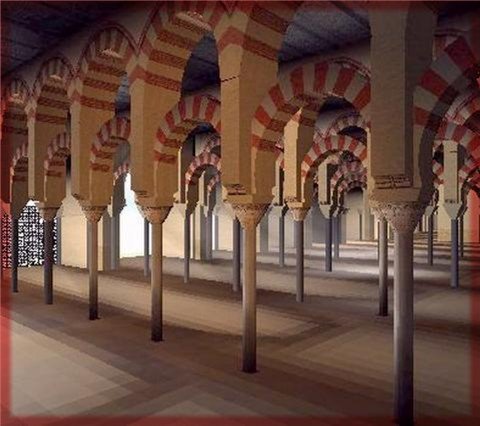
Spain's Islamic legacy
Mar 8, 2007 at 12:20 PM
In Islamic Spain, the high civilization of the Umayyad caliphs in Damascus was first continued, then exceeded, as both eastern and homegrown scholars and artists found welcoming and openhanded patrons in al-Andalus. One example is the ninth-century scholar ‘Abbas ibn Firnas, who experimented with flight some 600 years before Leonardo da Vinci and constructed a planetarium in which the planets actually revolved.
he Medieval Christians of Spain had a legend that Roderick, the last king of the Visigoths, was responsible for unleashing the Arab invasion of the Iberian Peninsula because, in defiance of his plighted word, he unlocked the gates of an enchanted palace he had sworn not to tamper with. As far as the West was concerned, the Arab invasion did unlock an enchanted palace. Following the collapse of the Roman Empire, Vandals, Huns and Visigoths had pillaged and burned their way through the Iberian Peninsula, establishing ephemeral kingdoms which lasted only as long as loot poured in, and were then destroyed in their turn. Then, without warning, in the year 711, came the Arabs—to settle, fall in love with the land and create the first civilization Europe had known since the Roman legions gave up the unequal fight against the barbarian hordes.
Spain first prospered under the rule of the Umayyads, who established a dynasty there after they had lost the caliphate in the East to the Abbasids. At first, the culture of the Umayyad court at Córdoba was wholly derivative. Fashions, both in literature and dress, were imitiative of those current in the Abbasids’ newly founded capital of Baghdad. Scholars from the more sophisticated lands to the east were always assured of a warm reception at the court of Córdoba, where their colleagues would listen avidly for news of what was being discussed in the capital, what people were wearing, what songs were being sung, and—above all—what books were being read.
slamic culture was pre-eminently a culture of the book. The introduction of paper from China in 751 gave an impetus to learning and an excitement about ideas which the world had never before known. Books became more available than they had been even in Rome, and incomparably cheaper than they were in the Latin West, where they continued to be written on expensive parchment. In the 12th century, a man sold 120 acres of land in order to buy a single Book of Hours. In the ninth century, the library of the monastery of St. Gall was the largest in Europe, boasting 36 volumes. At the same time, that of Córdoba contained 500,000. The cultural lag between East and West in the Middle Ages can be attributed partly to the fact that the Arabs had paper, while the Latin West did not.
It took much more than paper to create an intellectual and scientific culture like that of Islamic Spain, of course. Islam, with its tolerance and encouragement of both secular and religious learning, created the necessary climate for the exchange of ideas. The court of Córdoba, like that of Baghdad, was open to Muslims, Jews and Christians alike, and one prominent bishop complained that young Christian men were devoting themselves to the study of Arabic, rather than Latin—a reflection of the fact that Arabic, in a surprisingly short time, had become the international language of science, as English has today.
Islamic culture in Spain began to flourish in earnest during the reign of ‘Abd al-Rahman II of Córdoba, as Arabic spread increasingly among his non-Muslim subjects, especially in the cities, leading to a great flowering of intellectual activity of all kinds.
In a courtly society, the tastes and predilections of the ruler set the tone for society at large, and ‘Abd al-Rahman II, passionately interested in both the religious and the secular sciences, was determined to show the world that his court was in no way inferior to the court of the caliphs at Baghdad. To this end, therefore, he actively recruited scholars by offering handsome inducements to overcome their initial reluctance to live in what many in the lands of the East considered the provinces. As a result, many scholars, poets, philosophers, historians and musicians migrated to al-Andalus, and established the basis of the intellectual tradition and educational system which made Spain so outstanding for the next 400 years.
Another result was that an infrastructure of public and private libraries, mosques, hospitals and research institutions rapidly grew up and famous scholars in the East, hearing of these amenities, flocked to the West. They in turn attracted students of their own; in the Islamic world it was not at all unusual for a student to travel thousands of miles to study at the feet of a famous professor.
One of the earliest of these scholars was ‘Abbas ibn Firnas, who died in the year 888 and who, had he lived in the Florence of the Medici, would have been a “Renaissance man.” He came to Córdoba to teach music, then a branch of mathematical theory, but—not a man to limit himself to a single field of study—soon became interested in the mechanics of flight. He constructed a pair of wings, made out of feathers in a wooden frame, and attempted to fly—anticipating Leonardo da Vinci by some 600 years.
Luckily, ‘Abbas survived, and, undiscouraged, turned his mind to the construction of a planetarium in which the planets actually revolved—it would be extremely interesting to know the details of the gearing mechanism. It also simulated such celestial phenomena as thunder and lightning and was, of course, a wild success. Next ‘Abbas turned to the mathematical problems involved in the regularity of the facets of certain crystals and evolved a formula for manufacturing artificial crystals.
t must be remembered that a knowledge of the achievements of men like ‘Abbas has come to us purely by chance. It has been estimated that today there are 250,000 Arabic manuscripts in western and eastern libraries, including private collections. Yet in the 10th century, private libraries existed which contained as many as 500,000 books. Literally millions of books must have perished, and with them the achievements of a great many scholars and scientists whose books, had they survived, might have changed the course of history. As it is, even now, only a tiny proportion of existing Arabic scientific texts has been studied, and it will take years to form a more exact idea of the contributions of Muslim scientists to the history of ideas.
One of the fields most assiduously cultivated in Spain was natural science. Although Andalusian scholars did not make contributions as fundamental as those made by their colleagues in the East, those that they did make had more effect on the later development of science and technology, for it was through Spain and the scholars of al-Andalus that these ideas reached the West.
No school of translators comparable to the House of Wisdom of al-Ma’mun existed in Spain, and Andalusian scholars seem not to have interested themselves in the natural sciences until the translations of the House of Wisdom reached them.
Interest in mathematics, astronomy, and medicine was always lively, however, because of their obvious utility—mathematics for commercial purposes, computation of the rather complicated Islamic laws of inheritance, and as a basis for measuring distances. Astronomy was useful for determining the times of prayer and adjusting the calendar, and the study of medicine needed no apology. The introduction of the new Aristotelian ideas, however, even in Arab dress, aroused a certain amount of suspicion in the conservative West, and it was some time before public opinion would accept that Aristotelian logic did not conflict with the revelation of Islam.
Part of the suspicion with which certain of the ideas emanating from the scholars of the Abbasid court were viewed was due to an inadequate distinction between sciences and pseudo-sciences. This was a distinction which the Muslims made at a much earlier date than western scholars, who, even during the Renaissance, tended to confound astronomy with astrology, chemistry with alchemy. Ibn Hazm, a leading Andalusian scholar of the 11th century and staunchly conservative, was very outspoken on this point. People who advocated the efficacy of talismans, magic, alchemy, and astrology he calls shameless liars. This rational approach did much to make Islam preeminent in the natural sciences.
The study of mathematics and astronomy went hand in hand. Al-Khwarizmi’s famous book entitled The Calculation of Integration and Equation reached al-Andalus at an early date, and became the foundation of much later speculation. In it, Al-Khwarizmi dealt with equations, algebraic multiplication and division, measurement of surfaces and other questions. Al-Khwarizmi was the first to introduce the use of what he called “Indian” and we call “Arabic” numerals. The exact method of transmission of these numerals—and the place-value idea which they embodied—is not known, but the symbols used to represent the numbers had slightly different forms in eastern and western Islam, and the forms of our numerals are derived from those used in al-Andalus. The work of al-Khwarizmi, which now only survives in a 12th-century Latin translation made in Spain, together with a translation of Euclid’s Elements, became the two foundations of subsequent mathematical developments in al-Andalus.
he first original mathematician and astronomer of al-Andalus was the 10th century’s Maslama al-Majriti. He had been preceded by competent scientists—men like Ibn Abi ‘Ubaida of Valencia, who in the ninth century was a leading astronomer, and the emigré from Baghdad, Ibn Taimiyyah, who was both a well-known physician and an astronomer—but al-Majriti was in a class by himself. He wrote a number of works on mathematics and astronomy, studied and elaborated the Arabic translation of Ptolemy’s Almagest and enlarged and corrected the astronomical tables of al-Khwarizmi himself. He compiled conversion tables, in which the dates of the Persian calendar were related to hijri dates, so that for the first time the events of Persia’s past could be dated with precision.
Al-Zarqali, known to the Latin West as Arzachel, was another leading mathematician and astronomer who flourished in Córdoba in the 11th century. He combined theoretical knowledge with technical skills, and excelled at the construction of precision instruments for astronomical use. He built a waterclock capable of determining the hours of the day and night and indicating the days of the lunar month. He contributed to the compilation of the famous Toledan Tables, a highly accurate compilation of astronomical data. His Book of Tables, written in the form of an almanac (almanac is an Arabic word meaning “climate,” originally indicating the stations of the moon) contains tables which allow one to find on what day the Coptic, Roman, lunar and Persian months begin; others give the position of the various planets at any given time; still others allow prediction of solar and lunar eclipses. He also compiled valuable tables of latitude and longitude; many of his works were translated, both into Spanish and into Latin.
Still another luminary was al-Bitruji (the Latin scholars of the Middle Ages called him Alpetragius), who developed a new theory of stellar movement and wrote the Book of Form in which it is detailed.
The influence of these astronom- ical works was immense. Today, for example, the constellations still bear the names given them by Muslim astronomers—Acrab (from ‘aqrab, “scorpion”), Altair (from al-ta’ir, “the flyer”), Deneb (from dhanb, “tail”), Pherkard (from farqad, “calf”)—and words such as zenith, nadir and azimuth, all still in use today, recall the works of the Muslim scholars of al-Andalus.
ut the Muslim science par excellence was the study of medicine. Interest in medicine goes back to the very earliest times. The Prophet himself stated that there was a remedy for every illness, and was aware that some diseases were contagious.
The great contribution of the Arabs was to put the study of medicine on a scientific footing and eliminate superstition and harmful folk-practices. Medicine was considered a highly technical calling, and one which required long study and training. Elaborate codes were formulated to regulate the professional conduct of doctors. It was not enough to have a mastery of one’s subject in order to practice medicine. Certain moral qualities were mandatory. Ibn Hazm said that a doctor should be kind, understanding, friendly, good, able to endure insults and adverse criticism; he must keep his hair short, and his fingernails as well; he must wear clean, white clothes and behave with dignity.
Before doctors could practice, they had to pass an examination, and if they passed they had to take the Hippocratic oath, which, if neglected, could lead to dismissal.
Hospitals were similarly organized. The large one built in Córdoba was provided with running water and baths, and had different sections for the treatment of various diseases, each of which was headed by a specialist. Hospitals were required to be open 24 hours a day to handle emergency cases, and could not turn any patient away.
Muslim physicians made many important additions to the body of medical knowledge which they inherited from the Greeks. Ibn al-Nafis, for example, discovered the lesser circulation of the blood hundreds of years before Harvey, and ideas of quarantine sprang from an empirical notion of contagion.
Another example is Ibn Juljul, who was born in Córdoba in 943, became a leading physician by the age of 24 (he began his studies of medicine at 14) and compiled a commentary on the De Materia Medica of Dioscorides and a special treatise on drugs found in al-Andalus. In his Categories of Physicians, composed at the request of one of the Umayyad princes, he also presents a history of the medical profession from the time of Aesculapius to his own day.
During the 10th century, al-Andalus produced a large number of excellent physicians. Several went to Baghdad, where they studied Greek medical works under the famous translators Thabit ibn Qurra and Thabit ibn Sinan. On their return, they were lodged in the government palace complex at Madinat al-Zahra. One of these men, Ahmad ibn Harran, was placed in charge of a dispensary which provided free medical care and food to poor patients.
Ibn Shuhaid, also known as a popular doctor, wrote a fundamental work on the use of drugs. He—like many of his contemporaries—recommended drugs only if the patient did not respond to dietary treatment, and said that if they must be used, simple drugs should be employed in all cases but the most serious.
Al-Zahrawi, who died in 1013, was the most famous surgeon of the Middle Ages. He was court physician of al-Hakam II, and his great work, the Tasrif, was translated into Latin by Gerard of Cremona and became a leading medical text in European universities in the later Middle Ages. The section on surgery contains a number of illustrations of surgical instruments of elegant, functional design and great precision. It describes lithotrites, amputations, ophthalmic and dental surgery and the treatment of wounds and fractures.
Ibn Zuhr, known as Avenzoar, who died in 1162, was born in Seville and earned a great reputation throughout North Africa and Spain. He described abscesses and mediastinal tumors for the first time, and made original experiments in therapeutics. One of his works, the Taysir, was translated into Latin in 1280 and became a standard work.
n outgrowth of the interest in medicine was the study of botany. The most famous Andalusian botanist was Ibn Baitar, who wrote a famous book called Collection of Simple Drugs and Food. It is an alphabetically arranged compendium of medicinal plants of all sorts, most of which were native to Spain and North Africa, which he had spent a lifetime gathering. Where possible, he gives the Berber, Arabic, and sometimes Romance names of the plant, so that for linguists his work is of special interest. In each article, he gives information about the preparation of the drug and its administration, purpose and dosage.
The last of the great Andalusian physicians was Ibn al-Khatib, who was also a noted historian, poet, and statesman. Among his other works, he wrote an important work on the theory of contagion: “The fact of infection becomes clear to the investigator who notices how he who establishes contact with the afflicted gets the disease, whereas he who is not in contact remains safe, and how transmitting is effected through garments, vessels, and earrings.”
Ibn al-Khatib was the last representative of the Andalusian medical tradition. Soon after his death, the energies of the Muslims of al-Andalus were wholly absorbed in the long, costly struggle against the Christian reconquista.
nother field that interested the scholars of al-Andalus was geography, and many of the finest Muslim works in this field were produced there. Economic and political considerations played some part in the development of this field of study, but it was above all their all-consuming curiosity about the world and its inhabitants that motivated the scholars who devoted themselves to the description of the earth and its inhabitants. The first steps had been taken in the East, when “books of routes,” as they were called, were compiled for the use of the postmasters of the early Abbasid caliphs. Soon, reports on faraway lands, their commercial products and major physical features were compiled for the information of the caliph and his ministers. Advances in astronomy and mathematics made the plotting of this information on maps feasible, and soon cartography became an important discipline in its own right.
Al-Khwarizmi, who did so much to advance the science of mathematics, was also one of the earliest scientific descriptive geographers. Basing his work on information made available through the Arabic translation of Ptolemy, al-Khwarizmi wrote a book called The Form of the Earth, which included maps of the heavens and of the earth. In al-Andalus, this work was carried forward by Ibn Muhammad al-Razi, who died in 936, and who wrote a basic geography of al-Andalus for administrative purposes. Muhammad ibn Yusuf al-Warraq, a contemporary of al-Razi, wrote a similar work describing the topography of North Africa. The wide-ranging commercial relations of al-Andalus allowed the collection, from returning merchants, of a great deal of detailed information about regions as far north as the Baltic. Ibrahim ibn Ya‘qub, for example, who traveled widely in Europe and the Balkans in the late ninth century—he must have been a brave man indeed—left itineraries of his travels.
Two men who wrote in the 11th century collected much of the information assembled by their predecessors and put it into convenient form. One of them, al-Bakri, is particularly interesting. Born in Saltes in 1014, al-Bakri was the son of the governor of the province of Huelva and Saltes. Al-Bakri himself was an important minister at the court in Seville and undertook several diplomatic missions. An accomplished scholar as well as litérateur, he wrote works on history, botany and geography as well as poetry and literary essays. One of his two important geographical works is devoted to the geography of the Arabian Peninsula, with particular attention to the elucidation of its place names. It is arranged alphabetically, and lists the names of villages, towns, wadis and monuments which he culled from the hadith and histories. His other major work has not survived in its entirety, but it was an encyclopedic treatment of the entire world.
l-Bakri arranged his material by country—preceding each entry by a short historical introduction—and describes the people, customs, climate, geographical features and the major cities, with anecdotes about them. He says of the inhabitants of Galicia, for example: “They are treacherous, dirty and bathe once or twice a year, even then with cold water; they never wash their clothes until they are worn out because they claim that the dirt accumulated as the result of their sweat softens their body.” Perhaps the most famous geographer of the time was al-Idrisi, “the Strabo of the Arabs.” Born in 1100 and educated in Córdoba, al-Idrisi traveled widely, visiting Spain, North Africa and Anatolia, until he eventually settled in Sicily. There he was employed by the Norman king Roger ii to write a systematic geography of the world, which is still extant, and is usually known as The Book of Roger.
In it, al-Idrisi describes the world systematically, following the Greek division of it into seven “climes,” each divided into 10 sections. Each of the climes is mapped—and the maps are highly accurate for the time in which they were compiled. He gives the distances between major cities and describes the customs, people, products and climate of the entire known world. He even records the voyage of a Moroccan navigator who was blown off course in the Atlantic, sailed for 30 days, and returned to tell of a fertile land to the west inhabited by naked savages.
The information contained in The Book of Roger was engraved on a silver planisphere, which was one of the wonders of the age.
Al-Andalus also produced the authors of two of the most interesting travel books ever written. Each exists in good English translation. The first is by Ibn Jubair, secretary to the governor of Granada who, in 1183, made the Hajj, and wrote a book about his journey, called simply Travels. The book is in the form of a diary, and gives a detailed account of the eastern Mediterranean world at the height of the Crusades. It is written in clear, elegant style, and is filled with the perceptive, intelligent comments of a tolerant—and often witty—man.
The most famous of all the Andalusian travelers was Ibn Battuta —the greatest tourist of his age, and perhaps of any. He went to North Africa, Syria, Makkah, Medina and Iraq. He went to Yemen, sailed down the Nile, the Red Sea, Asia Minor, and the Black Sea. He went to the Crimea and to Constantinople. He went to Afghanistan, India and China. He died in Granada at the age of 73.
t is impossible to do justice to all the scholars of al-Andalus who devoted themselves to the study of history and linguistic sciences. These were the prime “social sciences” cultivated by the Arabs, and both were brought to a high level of art in al-Andalus. For example, Ibn al-Khatib, whose theory of contagious diseases we have touched on already, was the author of the finest history of Granada that has come down to us.
Ibn al-Khatib was born in 1313, near Granada, and followed the traditional educational curriculum of his time—he studied grammar, poetry, natural sciences and Islamic law, as well, of course, as the Qur’an. His father, an important official, was killed by the Christians in 1340. The ruler of Granada invited the son to occupy the post of secretary in the department of correspondence. He soon became the confidant of the ruler and gained a position of great power.
Despite his busy political career, Ibn al-Khatib found time to write more than 50 books on travel, medicine, poetry, music, history, politics and theology.
The achievements of Ibn al-Khatib were rivaled only by those of his near contemporary Ibn Khaldun, the first historian to seek to develop and explicate the general laws which govern the rise and decline of civilizations. His huge, seven-volume history is entitled The Book of Examples and Collection from Early and Later Information Concerning the Days of Arabs, Non-Arabs and Berbers. The first volume, entitled Introduction, gives a profound and detailed analysis of Islamic society and indeed of human society in general, for he constantly refers to other cultures for comparative purposes. He gives a sophisticated analysis of how human society evolved from nomadism to urban centers, and how and why these urban centers decay and finally succumb to less developed invaders. Many of the profoundly disturbing questions raised by Ibn Khaldun have still not received the attention they should from all thinking people. Certainly, anyone interested in the problems of the rise and fall of civilizations, the decay of cities, or the complex relationship between technologically advanced societies and traditional ones should read Ibn Khaldun’s Introduction.
nother great area of Andalusian intellectual activity was philosophy, but it is impossible to do more than glance at this difficult and specialized study. From the ninth century, Andalusian scholars, like those in Baghdad, had to deal with the theological problems posed by the introduction of Greek philosophy into a context of Islam. How could reason be reconciled with revelation? This was the central question.
Photo: Tor Eigeland
Ibn Hazm was one of the first to deal with this problem. He supported certain Aristotelian concepts with enthusiasm and rejected others. For example, he wrote a large and detailed commentary on Aristotle’s Posterior Analects, that abstruse work on logic. Interestingly, Ibn Hazm appears to have had no trouble relating logic to Islam—in fact, he gives illustrative examples of how it can be used in solving legal problems, drawn from the body of Islamic law. Nothing better illustrates the ability of Islam to assimilate foreign ideas and acclimatize them than Ibn Hazm’s words in the introduction to his work: “Let it be known that he who reads this book of ours will find that the usefulness of this kind of work is not limited to one single discipline but includes the Qur’an, hadith and legal decisions concerning what is permissible and what is not, and what is obligatory and what is lawful.”
Ibn Hazm considered logic a useful tool, and philosophy to be in harmony, or at least not in conflict, with revelation. He has been described as “one of the giants of the intellectual history of Islam,” but it is difficult to form a considered judgment of a man who wrote more than 400 books, most of which have perished or still remain in manuscript.
Ibn Bajjah, whom western scholastic theologians called Avempace, was another great Andalusian philosopher. But it was Averroës—Ibn Rushd—who earned the greatest reputation. He was an ardent Aristotelian, and his works had a lasting effect, in their Latin translation, on the development of European philosophy.
Islamic technological innovations also played their part in the legacy that al-Andalus left to medieval Europe. Paper has been mentioned, but there were others of great importance—the windmill, new techniques of working metal, making ceramics, building, weaving and agriculture. The people of al-Andalus had a passion for gardens, combining their love of beauty with their interest in medicinal plants. Two important treatises on agriculture—one of which was partially translated into Romance in the Middle Ages, were written in al-Andalus. Ibn al-‘Awwam, the author of one of these treatises, lists 584 species of plants and gives precise instructions regarding their cultivation and use. He writes, for example, of how to graft trees, make hybrids, stop blights and insect pests, and how to make floral essences and perfumes.
This area of technological achievement has not yet been examined in detail, but it had as profound an influence on medieval European material culture as the Muslim commentators on Aristotle had on medieval European intellectuals. For these were the arts of civilization, the arts that make life a pleasure rather than a burden, and without which philosophical speculation is an arid exercise.
Paul Lunde, an independent scholar who divides his time between Seville and Cambridge, England, researches and writes about the Middle East. His most recent book is Islam: Culture, Faith and History (2001, Dorling Kindersley).
Michael Grimsdale, one of Britain’s foremost illustrators, paints portraits, animals, sports and travel themes in a variety of media. Widely collected and exhibited, his paintings have also appeared in advertising, books and magazines.
spain
In Islamic Spain, the high civilization of the Umayyad caliphs in Damascus was first continued, then exceeded, as both eastern and homegrown scholars and artists found welcoming and openhanded patrons in al-Andalus. One example is the ninth-century scholar ‘Abbas ibn Firnas, who experimented with flight some 600 years before Leonardo da Vinci and constructed a planetarium in which the planets actually revolved.
he Medieval Christians of Spain had a legend that Roderick, the last king of the Visigoths, was responsible for unleashing the Arab invasion of the Iberian Peninsula because, in defiance of his plighted word, he unlocked the gates of an enchanted palace he had sworn not to tamper with. As far as the West was concerned, the Arab invasion did unlock an enchanted palace. Following the collapse of the Roman Empire, Vandals, Huns and Visigoths had pillaged and burned their way through the Iberian Peninsula, establishing ephemeral kingdoms which lasted only as long as loot poured in, and were then destroyed in their turn. Then, without warning, in the year 711, came the Arabs—to settle, fall in love with the land and create the first civilization Europe had known since the Roman legions gave up the unequal fight against the barbarian hordes.
Spain first prospered under the rule of the Umayyads, who established a dynasty there after they had lost the caliphate in the East to the Abbasids. At first, the culture of the Umayyad court at Córdoba was wholly derivative. Fashions, both in literature and dress, were imitiative of those current in the Abbasids’ newly founded capital of Baghdad. Scholars from the more sophisticated lands to the east were always assured of a warm reception at the court of Córdoba, where their colleagues would listen avidly for news of what was being discussed in the capital, what people were wearing, what songs were being sung, and—above all—what books were being read.
slamic culture was pre-eminently a culture of the book. The introduction of paper from China in 751 gave an impetus to learning and an excitement about ideas which the world had never before known. Books became more available than they had been even in Rome, and incomparably cheaper than they were in the Latin West, where they continued to be written on expensive parchment. In the 12th century, a man sold 120 acres of land in order to buy a single Book of Hours. In the ninth century, the library of the monastery of St. Gall was the largest in Europe, boasting 36 volumes. At the same time, that of Córdoba contained 500,000. The cultural lag between East and West in the Middle Ages can be attributed partly to the fact that the Arabs had paper, while the Latin West did not.
It took much more than paper to create an intellectual and scientific culture like that of Islamic Spain, of course. Islam, with its tolerance and encouragement of both secular and religious learning, created the necessary climate for the exchange of ideas. The court of Córdoba, like that of Baghdad, was open to Muslims, Jews and Christians alike, and one prominent bishop complained that young Christian men were devoting themselves to the study of Arabic, rather than Latin—a reflection of the fact that Arabic, in a surprisingly short time, had become the international language of science, as English has today.
Islamic culture in Spain began to flourish in earnest during the reign of ‘Abd al-Rahman II of Córdoba, as Arabic spread increasingly among his non-Muslim subjects, especially in the cities, leading to a great flowering of intellectual activity of all kinds.
In a courtly society, the tastes and predilections of the ruler set the tone for society at large, and ‘Abd al-Rahman II, passionately interested in both the religious and the secular sciences, was determined to show the world that his court was in no way inferior to the court of the caliphs at Baghdad. To this end, therefore, he actively recruited scholars by offering handsome inducements to overcome their initial reluctance to live in what many in the lands of the East considered the provinces. As a result, many scholars, poets, philosophers, historians and musicians migrated to al-Andalus, and established the basis of the intellectual tradition and educational system which made Spain so outstanding for the next 400 years.
Another result was that an infrastructure of public and private libraries, mosques, hospitals and research institutions rapidly grew up and famous scholars in the East, hearing of these amenities, flocked to the West. They in turn attracted students of their own; in the Islamic world it was not at all unusual for a student to travel thousands of miles to study at the feet of a famous professor.
One of the earliest of these scholars was ‘Abbas ibn Firnas, who died in the year 888 and who, had he lived in the Florence of the Medici, would have been a “Renaissance man.” He came to Córdoba to teach music, then a branch of mathematical theory, but—not a man to limit himself to a single field of study—soon became interested in the mechanics of flight. He constructed a pair of wings, made out of feathers in a wooden frame, and attempted to fly—anticipating Leonardo da Vinci by some 600 years.
Luckily, ‘Abbas survived, and, undiscouraged, turned his mind to the construction of a planetarium in which the planets actually revolved—it would be extremely interesting to know the details of the gearing mechanism. It also simulated such celestial phenomena as thunder and lightning and was, of course, a wild success. Next ‘Abbas turned to the mathematical problems involved in the regularity of the facets of certain crystals and evolved a formula for manufacturing artificial crystals.
t must be remembered that a knowledge of the achievements of men like ‘Abbas has come to us purely by chance. It has been estimated that today there are 250,000 Arabic manuscripts in western and eastern libraries, including private collections. Yet in the 10th century, private libraries existed which contained as many as 500,000 books. Literally millions of books must have perished, and with them the achievements of a great many scholars and scientists whose books, had they survived, might have changed the course of history. As it is, even now, only a tiny proportion of existing Arabic scientific texts has been studied, and it will take years to form a more exact idea of the contributions of Muslim scientists to the history of ideas.
One of the fields most assiduously cultivated in Spain was natural science. Although Andalusian scholars did not make contributions as fundamental as those made by their colleagues in the East, those that they did make had more effect on the later development of science and technology, for it was through Spain and the scholars of al-Andalus that these ideas reached the West.
No school of translators comparable to the House of Wisdom of al-Ma’mun existed in Spain, and Andalusian scholars seem not to have interested themselves in the natural sciences until the translations of the House of Wisdom reached them.
Interest in mathematics, astronomy, and medicine was always lively, however, because of their obvious utility—mathematics for commercial purposes, computation of the rather complicated Islamic laws of inheritance, and as a basis for measuring distances. Astronomy was useful for determining the times of prayer and adjusting the calendar, and the study of medicine needed no apology. The introduction of the new Aristotelian ideas, however, even in Arab dress, aroused a certain amount of suspicion in the conservative West, and it was some time before public opinion would accept that Aristotelian logic did not conflict with the revelation of Islam.
Part of the suspicion with which certain of the ideas emanating from the scholars of the Abbasid court were viewed was due to an inadequate distinction between sciences and pseudo-sciences. This was a distinction which the Muslims made at a much earlier date than western scholars, who, even during the Renaissance, tended to confound astronomy with astrology, chemistry with alchemy. Ibn Hazm, a leading Andalusian scholar of the 11th century and staunchly conservative, was very outspoken on this point. People who advocated the efficacy of talismans, magic, alchemy, and astrology he calls shameless liars. This rational approach did much to make Islam preeminent in the natural sciences.
The study of mathematics and astronomy went hand in hand. Al-Khwarizmi’s famous book entitled The Calculation of Integration and Equation reached al-Andalus at an early date, and became the foundation of much later speculation. In it, Al-Khwarizmi dealt with equations, algebraic multiplication and division, measurement of surfaces and other questions. Al-Khwarizmi was the first to introduce the use of what he called “Indian” and we call “Arabic” numerals. The exact method of transmission of these numerals—and the place-value idea which they embodied—is not known, but the symbols used to represent the numbers had slightly different forms in eastern and western Islam, and the forms of our numerals are derived from those used in al-Andalus. The work of al-Khwarizmi, which now only survives in a 12th-century Latin translation made in Spain, together with a translation of Euclid’s Elements, became the two foundations of subsequent mathematical developments in al-Andalus.
he first original mathematician and astronomer of al-Andalus was the 10th century’s Maslama al-Majriti. He had been preceded by competent scientists—men like Ibn Abi ‘Ubaida of Valencia, who in the ninth century was a leading astronomer, and the emigré from Baghdad, Ibn Taimiyyah, who was both a well-known physician and an astronomer—but al-Majriti was in a class by himself. He wrote a number of works on mathematics and astronomy, studied and elaborated the Arabic translation of Ptolemy’s Almagest and enlarged and corrected the astronomical tables of al-Khwarizmi himself. He compiled conversion tables, in which the dates of the Persian calendar were related to hijri dates, so that for the first time the events of Persia’s past could be dated with precision.
Al-Zarqali, known to the Latin West as Arzachel, was another leading mathematician and astronomer who flourished in Córdoba in the 11th century. He combined theoretical knowledge with technical skills, and excelled at the construction of precision instruments for astronomical use. He built a waterclock capable of determining the hours of the day and night and indicating the days of the lunar month. He contributed to the compilation of the famous Toledan Tables, a highly accurate compilation of astronomical data. His Book of Tables, written in the form of an almanac (almanac is an Arabic word meaning “climate,” originally indicating the stations of the moon) contains tables which allow one to find on what day the Coptic, Roman, lunar and Persian months begin; others give the position of the various planets at any given time; still others allow prediction of solar and lunar eclipses. He also compiled valuable tables of latitude and longitude; many of his works were translated, both into Spanish and into Latin.
Still another luminary was al-Bitruji (the Latin scholars of the Middle Ages called him Alpetragius), who developed a new theory of stellar movement and wrote the Book of Form in which it is detailed.
The influence of these astronom- ical works was immense. Today, for example, the constellations still bear the names given them by Muslim astronomers—Acrab (from ‘aqrab, “scorpion”), Altair (from al-ta’ir, “the flyer”), Deneb (from dhanb, “tail”), Pherkard (from farqad, “calf”)—and words such as zenith, nadir and azimuth, all still in use today, recall the works of the Muslim scholars of al-Andalus.
ut the Muslim science par excellence was the study of medicine. Interest in medicine goes back to the very earliest times. The Prophet himself stated that there was a remedy for every illness, and was aware that some diseases were contagious.
The great contribution of the Arabs was to put the study of medicine on a scientific footing and eliminate superstition and harmful folk-practices. Medicine was considered a highly technical calling, and one which required long study and training. Elaborate codes were formulated to regulate the professional conduct of doctors. It was not enough to have a mastery of one’s subject in order to practice medicine. Certain moral qualities were mandatory. Ibn Hazm said that a doctor should be kind, understanding, friendly, good, able to endure insults and adverse criticism; he must keep his hair short, and his fingernails as well; he must wear clean, white clothes and behave with dignity.
Before doctors could practice, they had to pass an examination, and if they passed they had to take the Hippocratic oath, which, if neglected, could lead to dismissal.
Hospitals were similarly organized. The large one built in Córdoba was provided with running water and baths, and had different sections for the treatment of various diseases, each of which was headed by a specialist. Hospitals were required to be open 24 hours a day to handle emergency cases, and could not turn any patient away.
Muslim physicians made many important additions to the body of medical knowledge which they inherited from the Greeks. Ibn al-Nafis, for example, discovered the lesser circulation of the blood hundreds of years before Harvey, and ideas of quarantine sprang from an empirical notion of contagion.
Another example is Ibn Juljul, who was born in Córdoba in 943, became a leading physician by the age of 24 (he began his studies of medicine at 14) and compiled a commentary on the De Materia Medica of Dioscorides and a special treatise on drugs found in al-Andalus. In his Categories of Physicians, composed at the request of one of the Umayyad princes, he also presents a history of the medical profession from the time of Aesculapius to his own day.
During the 10th century, al-Andalus produced a large number of excellent physicians. Several went to Baghdad, where they studied Greek medical works under the famous translators Thabit ibn Qurra and Thabit ibn Sinan. On their return, they were lodged in the government palace complex at Madinat al-Zahra. One of these men, Ahmad ibn Harran, was placed in charge of a dispensary which provided free medical care and food to poor patients.
Ibn Shuhaid, also known as a popular doctor, wrote a fundamental work on the use of drugs. He—like many of his contemporaries—recommended drugs only if the patient did not respond to dietary treatment, and said that if they must be used, simple drugs should be employed in all cases but the most serious.
Al-Zahrawi, who died in 1013, was the most famous surgeon of the Middle Ages. He was court physician of al-Hakam II, and his great work, the Tasrif, was translated into Latin by Gerard of Cremona and became a leading medical text in European universities in the later Middle Ages. The section on surgery contains a number of illustrations of surgical instruments of elegant, functional design and great precision. It describes lithotrites, amputations, ophthalmic and dental surgery and the treatment of wounds and fractures.
Ibn Zuhr, known as Avenzoar, who died in 1162, was born in Seville and earned a great reputation throughout North Africa and Spain. He described abscesses and mediastinal tumors for the first time, and made original experiments in therapeutics. One of his works, the Taysir, was translated into Latin in 1280 and became a standard work.
n outgrowth of the interest in medicine was the study of botany. The most famous Andalusian botanist was Ibn Baitar, who wrote a famous book called Collection of Simple Drugs and Food. It is an alphabetically arranged compendium of medicinal plants of all sorts, most of which were native to Spain and North Africa, which he had spent a lifetime gathering. Where possible, he gives the Berber, Arabic, and sometimes Romance names of the plant, so that for linguists his work is of special interest. In each article, he gives information about the preparation of the drug and its administration, purpose and dosage.
The last of the great Andalusian physicians was Ibn al-Khatib, who was also a noted historian, poet, and statesman. Among his other works, he wrote an important work on the theory of contagion: “The fact of infection becomes clear to the investigator who notices how he who establishes contact with the afflicted gets the disease, whereas he who is not in contact remains safe, and how transmitting is effected through garments, vessels, and earrings.”
Ibn al-Khatib was the last representative of the Andalusian medical tradition. Soon after his death, the energies of the Muslims of al-Andalus were wholly absorbed in the long, costly struggle against the Christian reconquista.
nother field that interested the scholars of al-Andalus was geography, and many of the finest Muslim works in this field were produced there. Economic and political considerations played some part in the development of this field of study, but it was above all their all-consuming curiosity about the world and its inhabitants that motivated the scholars who devoted themselves to the description of the earth and its inhabitants. The first steps had been taken in the East, when “books of routes,” as they were called, were compiled for the use of the postmasters of the early Abbasid caliphs. Soon, reports on faraway lands, their commercial products and major physical features were compiled for the information of the caliph and his ministers. Advances in astronomy and mathematics made the plotting of this information on maps feasible, and soon cartography became an important discipline in its own right.
Al-Khwarizmi, who did so much to advance the science of mathematics, was also one of the earliest scientific descriptive geographers. Basing his work on information made available through the Arabic translation of Ptolemy, al-Khwarizmi wrote a book called The Form of the Earth, which included maps of the heavens and of the earth. In al-Andalus, this work was carried forward by Ibn Muhammad al-Razi, who died in 936, and who wrote a basic geography of al-Andalus for administrative purposes. Muhammad ibn Yusuf al-Warraq, a contemporary of al-Razi, wrote a similar work describing the topography of North Africa. The wide-ranging commercial relations of al-Andalus allowed the collection, from returning merchants, of a great deal of detailed information about regions as far north as the Baltic. Ibrahim ibn Ya‘qub, for example, who traveled widely in Europe and the Balkans in the late ninth century—he must have been a brave man indeed—left itineraries of his travels.
Two men who wrote in the 11th century collected much of the information assembled by their predecessors and put it into convenient form. One of them, al-Bakri, is particularly interesting. Born in Saltes in 1014, al-Bakri was the son of the governor of the province of Huelva and Saltes. Al-Bakri himself was an important minister at the court in Seville and undertook several diplomatic missions. An accomplished scholar as well as litérateur, he wrote works on history, botany and geography as well as poetry and literary essays. One of his two important geographical works is devoted to the geography of the Arabian Peninsula, with particular attention to the elucidation of its place names. It is arranged alphabetically, and lists the names of villages, towns, wadis and monuments which he culled from the hadith and histories. His other major work has not survived in its entirety, but it was an encyclopedic treatment of the entire world.
l-Bakri arranged his material by country—preceding each entry by a short historical introduction—and describes the people, customs, climate, geographical features and the major cities, with anecdotes about them. He says of the inhabitants of Galicia, for example: “They are treacherous, dirty and bathe once or twice a year, even then with cold water; they never wash their clothes until they are worn out because they claim that the dirt accumulated as the result of their sweat softens their body.” Perhaps the most famous geographer of the time was al-Idrisi, “the Strabo of the Arabs.” Born in 1100 and educated in Córdoba, al-Idrisi traveled widely, visiting Spain, North Africa and Anatolia, until he eventually settled in Sicily. There he was employed by the Norman king Roger ii to write a systematic geography of the world, which is still extant, and is usually known as The Book of Roger.
In it, al-Idrisi describes the world systematically, following the Greek division of it into seven “climes,” each divided into 10 sections. Each of the climes is mapped—and the maps are highly accurate for the time in which they were compiled. He gives the distances between major cities and describes the customs, people, products and climate of the entire known world. He even records the voyage of a Moroccan navigator who was blown off course in the Atlantic, sailed for 30 days, and returned to tell of a fertile land to the west inhabited by naked savages.
The information contained in The Book of Roger was engraved on a silver planisphere, which was one of the wonders of the age.
Al-Andalus also produced the authors of two of the most interesting travel books ever written. Each exists in good English translation. The first is by Ibn Jubair, secretary to the governor of Granada who, in 1183, made the Hajj, and wrote a book about his journey, called simply Travels. The book is in the form of a diary, and gives a detailed account of the eastern Mediterranean world at the height of the Crusades. It is written in clear, elegant style, and is filled with the perceptive, intelligent comments of a tolerant—and often witty—man.
The most famous of all the Andalusian travelers was Ibn Battuta —the greatest tourist of his age, and perhaps of any. He went to North Africa, Syria, Makkah, Medina and Iraq. He went to Yemen, sailed down the Nile, the Red Sea, Asia Minor, and the Black Sea. He went to the Crimea and to Constantinople. He went to Afghanistan, India and China. He died in Granada at the age of 73.
t is impossible to do justice to all the scholars of al-Andalus who devoted themselves to the study of history and linguistic sciences. These were the prime “social sciences” cultivated by the Arabs, and both were brought to a high level of art in al-Andalus. For example, Ibn al-Khatib, whose theory of contagious diseases we have touched on already, was the author of the finest history of Granada that has come down to us.
Ibn al-Khatib was born in 1313, near Granada, and followed the traditional educational curriculum of his time—he studied grammar, poetry, natural sciences and Islamic law, as well, of course, as the Qur’an. His father, an important official, was killed by the Christians in 1340. The ruler of Granada invited the son to occupy the post of secretary in the department of correspondence. He soon became the confidant of the ruler and gained a position of great power.
Despite his busy political career, Ibn al-Khatib found time to write more than 50 books on travel, medicine, poetry, music, history, politics and theology.
The achievements of Ibn al-Khatib were rivaled only by those of his near contemporary Ibn Khaldun, the first historian to seek to develop and explicate the general laws which govern the rise and decline of civilizations. His huge, seven-volume history is entitled The Book of Examples and Collection from Early and Later Information Concerning the Days of Arabs, Non-Arabs and Berbers. The first volume, entitled Introduction, gives a profound and detailed analysis of Islamic society and indeed of human society in general, for he constantly refers to other cultures for comparative purposes. He gives a sophisticated analysis of how human society evolved from nomadism to urban centers, and how and why these urban centers decay and finally succumb to less developed invaders. Many of the profoundly disturbing questions raised by Ibn Khaldun have still not received the attention they should from all thinking people. Certainly, anyone interested in the problems of the rise and fall of civilizations, the decay of cities, or the complex relationship between technologically advanced societies and traditional ones should read Ibn Khaldun’s Introduction.
nother great area of Andalusian intellectual activity was philosophy, but it is impossible to do more than glance at this difficult and specialized study. From the ninth century, Andalusian scholars, like those in Baghdad, had to deal with the theological problems posed by the introduction of Greek philosophy into a context of Islam. How could reason be reconciled with revelation? This was the central question.
Photo: Tor Eigeland
Ibn Hazm was one of the first to deal with this problem. He supported certain Aristotelian concepts with enthusiasm and rejected others. For example, he wrote a large and detailed commentary on Aristotle’s Posterior Analects, that abstruse work on logic. Interestingly, Ibn Hazm appears to have had no trouble relating logic to Islam—in fact, he gives illustrative examples of how it can be used in solving legal problems, drawn from the body of Islamic law. Nothing better illustrates the ability of Islam to assimilate foreign ideas and acclimatize them than Ibn Hazm’s words in the introduction to his work: “Let it be known that he who reads this book of ours will find that the usefulness of this kind of work is not limited to one single discipline but includes the Qur’an, hadith and legal decisions concerning what is permissible and what is not, and what is obligatory and what is lawful.”
Ibn Hazm considered logic a useful tool, and philosophy to be in harmony, or at least not in conflict, with revelation. He has been described as “one of the giants of the intellectual history of Islam,” but it is difficult to form a considered judgment of a man who wrote more than 400 books, most of which have perished or still remain in manuscript.
Ibn Bajjah, whom western scholastic theologians called Avempace, was another great Andalusian philosopher. But it was Averroës—Ibn Rushd—who earned the greatest reputation. He was an ardent Aristotelian, and his works had a lasting effect, in their Latin translation, on the development of European philosophy.
Islamic technological innovations also played their part in the legacy that al-Andalus left to medieval Europe. Paper has been mentioned, but there were others of great importance—the windmill, new techniques of working metal, making ceramics, building, weaving and agriculture. The people of al-Andalus had a passion for gardens, combining their love of beauty with their interest in medicinal plants. Two important treatises on agriculture—one of which was partially translated into Romance in the Middle Ages, were written in al-Andalus. Ibn al-‘Awwam, the author of one of these treatises, lists 584 species of plants and gives precise instructions regarding their cultivation and use. He writes, for example, of how to graft trees, make hybrids, stop blights and insect pests, and how to make floral essences and perfumes.
This area of technological achievement has not yet been examined in detail, but it had as profound an influence on medieval European material culture as the Muslim commentators on Aristotle had on medieval European intellectuals. For these were the arts of civilization, the arts that make life a pleasure rather than a burden, and without which philosophical speculation is an arid exercise.
Paul Lunde, an independent scholar who divides his time between Seville and Cambridge, England, researches and writes about the Middle East. His most recent book is Islam: Culture, Faith and History (2001, Dorling Kindersley).
Michael Grimsdale, one of Britain’s foremost illustrators, paints portraits, animals, sports and travel themes in a variety of media. Widely collected and exhibited, his paintings have also appeared in advertising, books and magazines.
spain
Osama bin Ladens of the world are a small minority
Osama bin Ladens of the world are a small minority
Mar 8, 2007 at 10:30 AM
More US Hispanics drawn to Islam
By Amy Green September 28, 2006
ORLANDO, FLA. – With her hijab and dark complexion, Catherine Garcia doesn't look like an Orlando native or a Disney tourist. When people ask where she's from, often they are surprised that it's not the Middle East but Colombia.
That's because Ms. Ms. Garcia, a bookstore clerk who immigrated to the US seven years ago, is Hispanic and Muslim. On this balmy afternoon at the start of Ramadan, the Islamic holy month, she is at her mosque dressed in long sleeves and a long skirt in keeping with the Islamic belief in modesty. "When I was in my country I never fit in the society. Here in Islam I feel like I fit with everything they believe," she says.
Garcia is one of a growing number of Hispanics across the US who have found common ground in a faith and culture bearing surprising similarities to their own heritage. From professionals to students to homemakers, they are drawn to the Muslim faith through marriage, curiosity and a shared interest in issues such as immigration.
The population of Hispanic Muslims has increased 30 percent to some 200,000 since 1999, estimates Ali Khan, national director of the American Muslim Council in Chicago. Many attribute the trend to a growing interest in Islam since the 2001 terrorist attacks and also to a collision between two burgeoning minority groups. They note that Muslims ruled Spain centuries ago, leaving an imprint on Spanish food, music, and language.
"Many Hispanics ... who are becoming Muslim, would say they are embracing their heritage, a heritage that was denied to them in a sense," says Ihsan Bagby, professor of Arabic and Islamic studies at the University of Kentucky.
The trend has spawned Latino Islamic organizations such as the Latino American Dawah Organization, established in 1997 by Hispanic converts in New York City. Today the organization is nationwide.
The growth in the Hispanic Muslim population is especially prevalent in New York, Florida, California, and Texas, where Hispanic communities are largest. In Orlando, the area's largest mosque, which serves some 700 worshipers each week, is located in a mostly Hispanic neighborhood. A few years ago it was rare to hear Spanish spoken at the mosque, says Imam Muhammad Musri, president of the Islamic Society of Central Florida.
Today there is a growing demand for books in Spanish, including the Koran, and requests for appearances on Spanish-language radio stations, Mr. Musri says. The mosque offers a Spanish-language education program in Islam for women on Saturdays. "I could easily see in the next few years a mosque that will have Spanish services and a Hispanic imam who will be leading the service," he says.
The two groups tend to be family-oriented, religious, and historically conservative politically, Dr. Bagby says. Many who convert are second- and third-generation Hispanic Americans.
The two groups also share an interest in social issues such as immigration, poverty, and healthcare. Earlier this year Muslims joined Hispanics in marches nationwide protesting immigration-reform proposals they felt were unfair.
In South Central Los Angeles, a group of Muslim UCLA students a decade ago established a medical clinic in this underserved area. Today the nonreligious University Muslim Medical Association Community Clinic treats some 16,000 patients, mostly Hispanic, who see it as a safe place to seek care without fear for their illegal status, says Mansur Khan, vice chairman of the board and one of the founders.
Although the clinic doesn't seek Muslim converts, Dr. Khan sees Hispanics taking an interest in his faith because it focuses on family, he says. One volunteer nurse founded a Latino Islamic organization in the area. Another Hispanic woman told Khan she felt drawn to the faith because of the head covering Muslim women wear. It reminded her of the Virgin Mary.
The trend is a sign that Islam is becoming more Americanized and more indigenous to the country, Bagby says. As Republican positions on issues such as immigration push Muslim Hispanics and blacks in a less conservative direction, Islam could move in the same direction. Muslim Hispanic and black involvement in American politics could demonstrate to Muslims worldwide the virtues of democracy, eventually softening fundamentalists. He believes the Osama bin Ladens of the world are a small minority, and that most fundamentalists are moving toward engagement with the West.
"The more Hispanics and other Americans [who] become Muslim, the stronger and wider the bridge between the Muslim community and the general larger American community," Bagby says. "Their words and approach have some weight because they are a source of pride for Muslims throughout the world."
Garcia left Colombia to study international business in the US. Always religious, she considered becoming a nun when she was younger. But her Catholic faith raised questions for her. She wondered about eating pork when the Bible forbids it, and about praying to Mary and the saints and not directly to God.
In the US she befriended Muslims and eventually converted to Islam. Her family in Colombia was supportive. Today she says her prayers in English, Spanish, and Arabic, and she eats Halal food in keeping with Islamic beliefs.
"It's the best thing that happened to me," says Garcia in soft, broken English. "I never expected to have so many blessings and be in peace like I am now."
Mar 8, 2007 at 10:30 AM
More US Hispanics drawn to Islam
By Amy Green September 28, 2006
ORLANDO, FLA. – With her hijab and dark complexion, Catherine Garcia doesn't look like an Orlando native or a Disney tourist. When people ask where she's from, often they are surprised that it's not the Middle East but Colombia.
That's because Ms. Ms. Garcia, a bookstore clerk who immigrated to the US seven years ago, is Hispanic and Muslim. On this balmy afternoon at the start of Ramadan, the Islamic holy month, she is at her mosque dressed in long sleeves and a long skirt in keeping with the Islamic belief in modesty. "When I was in my country I never fit in the society. Here in Islam I feel like I fit with everything they believe," she says.
Garcia is one of a growing number of Hispanics across the US who have found common ground in a faith and culture bearing surprising similarities to their own heritage. From professionals to students to homemakers, they are drawn to the Muslim faith through marriage, curiosity and a shared interest in issues such as immigration.
The population of Hispanic Muslims has increased 30 percent to some 200,000 since 1999, estimates Ali Khan, national director of the American Muslim Council in Chicago. Many attribute the trend to a growing interest in Islam since the 2001 terrorist attacks and also to a collision between two burgeoning minority groups. They note that Muslims ruled Spain centuries ago, leaving an imprint on Spanish food, music, and language.
"Many Hispanics ... who are becoming Muslim, would say they are embracing their heritage, a heritage that was denied to them in a sense," says Ihsan Bagby, professor of Arabic and Islamic studies at the University of Kentucky.
The trend has spawned Latino Islamic organizations such as the Latino American Dawah Organization, established in 1997 by Hispanic converts in New York City. Today the organization is nationwide.
The growth in the Hispanic Muslim population is especially prevalent in New York, Florida, California, and Texas, where Hispanic communities are largest. In Orlando, the area's largest mosque, which serves some 700 worshipers each week, is located in a mostly Hispanic neighborhood. A few years ago it was rare to hear Spanish spoken at the mosque, says Imam Muhammad Musri, president of the Islamic Society of Central Florida.
Today there is a growing demand for books in Spanish, including the Koran, and requests for appearances on Spanish-language radio stations, Mr. Musri says. The mosque offers a Spanish-language education program in Islam for women on Saturdays. "I could easily see in the next few years a mosque that will have Spanish services and a Hispanic imam who will be leading the service," he says.
The two groups tend to be family-oriented, religious, and historically conservative politically, Dr. Bagby says. Many who convert are second- and third-generation Hispanic Americans.
The two groups also share an interest in social issues such as immigration, poverty, and healthcare. Earlier this year Muslims joined Hispanics in marches nationwide protesting immigration-reform proposals they felt were unfair.
In South Central Los Angeles, a group of Muslim UCLA students a decade ago established a medical clinic in this underserved area. Today the nonreligious University Muslim Medical Association Community Clinic treats some 16,000 patients, mostly Hispanic, who see it as a safe place to seek care without fear for their illegal status, says Mansur Khan, vice chairman of the board and one of the founders.
Although the clinic doesn't seek Muslim converts, Dr. Khan sees Hispanics taking an interest in his faith because it focuses on family, he says. One volunteer nurse founded a Latino Islamic organization in the area. Another Hispanic woman told Khan she felt drawn to the faith because of the head covering Muslim women wear. It reminded her of the Virgin Mary.
The trend is a sign that Islam is becoming more Americanized and more indigenous to the country, Bagby says. As Republican positions on issues such as immigration push Muslim Hispanics and blacks in a less conservative direction, Islam could move in the same direction. Muslim Hispanic and black involvement in American politics could demonstrate to Muslims worldwide the virtues of democracy, eventually softening fundamentalists. He believes the Osama bin Ladens of the world are a small minority, and that most fundamentalists are moving toward engagement with the West.
"The more Hispanics and other Americans [who] become Muslim, the stronger and wider the bridge between the Muslim community and the general larger American community," Bagby says. "Their words and approach have some weight because they are a source of pride for Muslims throughout the world."
Garcia left Colombia to study international business in the US. Always religious, she considered becoming a nun when she was younger. But her Catholic faith raised questions for her. She wondered about eating pork when the Bible forbids it, and about praying to Mary and the saints and not directly to God.
In the US she befriended Muslims and eventually converted to Islam. Her family in Colombia was supportive. Today she says her prayers in English, Spanish, and Arabic, and she eats Halal food in keeping with Islamic beliefs.
"It's the best thing that happened to me," says Garcia in soft, broken English. "I never expected to have so many blessings and be in peace like I am now."
Subscribe to:
Posts (Atom)